
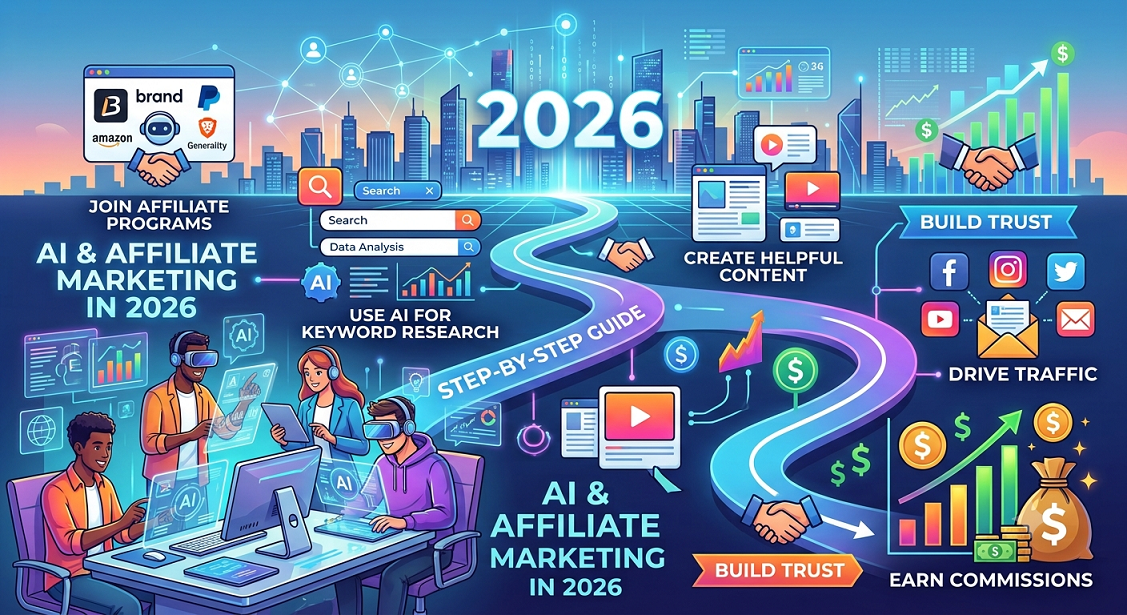
How AI Can Help You Succeed in Affiliate Marketing in 2026?
Discover practical strategies to find profitable niches, create quality content, improve SEO, and increase affiliate sales using AI tools while building long-term online income.
Hi everyone,
Affiliate marketing has been around for many years, but AI has completely changed how bloggers and content creators approach it. Tasks that once took hours—like keyword research, content planning, writing drafts, and creating promotional content—can now be completed much faster with AI tools.
However, one thing is important to understand:
AI doesn’t earn commissions for you. It simply helps you work smarter. The real income comes from building trust, creating helpful content, and recommending products that genuinely solve your audience’s problems.
If you’re new to affiliate marketing, here’s a simple step-by-step guide that I hope will help you get started.
What is Affiliate Marketing?
Affiliate marketing is a way to earn a commission by recommending products or services online.
The process is simple:
- Join an affiliate program.
- Get your unique affiliate link.
- Create helpful content.
- Someone clicks your link.
- They make a purchase.
- You earn a commission.
The more trust you build with your audience, the higher your chances of earning consistent income.
Why AI Makes Affiliate Marketing Easier
Before AI, bloggers spent countless hours researching topics, writing articles, creating images, and promoting content.
Today, AI can help with:
- Finding content ideas
- Keyword research
- Creating outlines
- Writing first drafts
- Generating FAQs
- Creating social media posts
- Email newsletter ideas
- Improving readability
- Repurposing content
This allows creators to focus more on strategy and audience building.
Step 1: Choose a Niche
Don’t promote everything.
Choose one niche that interests you.
Some popular niches include:
- AI Tools
- Blogging
- SEO
- WordPress
- Web Hosting
- Productivity
- Graphic Design
- Online Business
- Digital Marketing
- Finance
- Education
A focused niche helps you build authority.
Step 2: Join Affiliate Programs
After choosing your niche, sign up for relevant affiliate programs.
Examples include:
- AI software
- SEO tools
- Website hosting
- Email marketing platforms
- Graphic design tools
- Online learning platforms
Always recommend products you’ve actually used or researched thoroughly. Honest recommendations build trust.
Step 3: Use AI for Keyword Research
Instead of randomly writing articles, use AI to discover what people are searching for.
Ask questions like:
- What problems do beginners face?
- What comparisons are popular?
- What tutorials are missing?
- Which topics have low competition?
These questions often lead to valuable content ideas.
Step 4: Create Helpful Content
Affiliate marketing is not about inserting links everywhere.
It’s about solving problems.
Examples include:
- Product reviews
- Tutorials
- Comparison articles
- Beginner guides
- Case studies
- Frequently Asked Questions
- Best tools lists
Readers are more likely to click affiliate links when the content genuinely helps them.
Step 5: Let AI Create the First Draft
AI can create a structured draft quickly.
For example, ask AI to generate:
- Introduction
- Main headings
- FAQs
- Pros and cons
- Summary
Then improve everything with your own experience.
Never publish AI content without editing.
Step 6: Add Personal Experience
This is where many affiliate marketers fail.
Instead of simply saying:
“This tool is good.”
Explain:
- Why you chose it.
- What problem it solved.
- What you liked.
- What could be improved.
- Who should use it.
Readers appreciate honesty.
Step 7: Compare Products
Comparison articles often perform well.
Examples include:
- Tool A vs Tool B
- Free vs Paid
- Beginner vs Professional
People searching for comparisons are often close to making a purchase.
Step 8: Optimize for SEO
AI can help optimize content, but don’t overdo it.
Focus on:
- Clear headings
- Short paragraphs
- Internal links
- Helpful FAQs
- Easy readability
- Relevant keywords used naturally
Remember, write for people first and search engines second.
Step 9: Create Supporting Content
One affiliate article isn’t enough.
Build a content ecosystem around it.
For example, if you’re promoting an AI writing tool, also create articles like:
- How to write blog posts with AI
- Best prompts for bloggers
- AI SEO tips
- Common AI writing mistakes
- AI productivity hacks
These articles can naturally link to each other.
Step 10: Promote Your Content
Publishing is only half the job.
Use AI to create:
- Social media posts
- LinkedIn updates
- Facebook captions
- Email newsletters
- Short summaries
One article can become dozens of promotional posts.
Mistakes Beginners Should Avoid
I’ve noticed these mistakes quite often.
- Promoting products you don’t understand.
- Stuffing affiliate links everywhere.
- Writing only for commissions.
- Publishing AI-generated articles without editing.
- Ignoring user questions.
- Copying competitor reviews.
- Expecting instant income.
Affiliate marketing is a long-term strategy.
My Simple AI Workflow
Here’s the workflow I follow:
Research Topic
⬇️
Find Keywords
⬇️
Create Outline with AI
⬇️
Write First Draft
⬇️
Add Personal Experience
⬇️
Fact Check
⬇️
Optimize for SEO
⬇️
Insert Relevant Affiliate Links
⬇️
Publish
⬇️
Promote on Social Media
Don’t Recommend Everything
One lesson I’ve learned is that trust is more valuable than commissions.
If a product isn’t useful, don’t recommend it.
Sometimes saying,
“I don’t recommend this tool because…”
can actually increase your credibility.
Readers remember honesty.
Build an Email List
Many beginners focus only on search engines.
I think building an email list is equally important.
AI can help create:
- Weekly newsletters
- Product updates
- Educational emails
- Helpful tips
Email subscribers often become repeat visitors and loyal readers.
Track Your Results
Affiliate marketing isn’t just about publishing content.
Review your analytics regularly.
Questions to ask:
- Which articles get the most traffic?
- Which pages generate clicks?
- Which products convert best?
- Where are visitors leaving?
Use those insights to improve future content.
Final Thoughts
Affiliate marketing with AI isn’t about replacing your effort—it’s about multiplying your productivity.
AI can save time on research, drafting, SEO, and promotion, but your experience, honesty, and consistency are what convince readers to trust your recommendations.
If you’re just starting, don’t try to promote dozens of products. Pick one niche, create genuinely helpful content, and focus on solving real problems. Over time, you’ll build authority, attract loyal readers, and create multiple opportunities to earn affiliate commissions.
Remember, successful affiliate marketing isn’t built overnight. It’s built one useful article, one helpful recommendation, and one satisfied reader at a time.
Keyword Tags:
Affiliate Marketing, AI Affiliate Marketing, AI Blogging, Make Money Online, Blog Monetization, Passive Income, ChatGPT, AI Tools, SEO, Content Creation, Digital Marketing, Affiliate SEO, AI Productivity, Content Strategy, Affiliate Tips, Blogging Guide, Online Business, AI Workflow, Keyword Research, Affiliate Income
This post really resonates with me — affiliate marketing is exactly the income path I’m most interested in building as a blogger right now. The point about AI not earning commissions for you, but just helping you work smarter, is something I needed to hear honestly.
What stands out most to me is the “Step 6: Add Personal Experience” part. I think that’s where most beginners (myself included) get tempted to cut corners. It’s easy to let AI draft a generic review, but readers can tell when there’s no real experience behind it. I’m planning to focus on one niche first instead of spreading thin across multiple affiliate programs… seems like the smarter long-term move based on what you’ve outlined here.
Also appreciate the reminder about building an email list alongside SEO content. I’ve been too search-engine-focused so far and ignoring that completely.
Bookmarking this as a roadmap. Thanks for breaking it down so clearly!
Tags: Affiliate Marketing, AI Affiliate Marketing, Passive Income, Make Money Blogging, Blog Monetization, AI Tools, SEO, Content Strategy, Affiliate Tips, Online Business
Good comprehensive breakdown from @LinkBlogs. But let me add the part most affiliate marketing guides quietly skip over.
The workflow here is correct. The order of priorities is where most beginners get it wrong.
Everyone rushes to Step 2 (join affiliate programs) before they have done Step 1 (build an audience that actually trusts them). That is backwards. An affiliate link in front of a cold, unestablished audience converts at nearly zero regardless of how well-written the review is. The link is not the problem. The trust deficit is.
The comparison articles point is the most undervalued tip in this entire post. Here is why from a pure conversion standpoint: someone searching “Tool A vs Tool B” has already decided they are buying. They are choosing, not browsing. That search intent is worth ten times the traffic from a generic “best AI tools” article in terms of actual commission conversion.
Two things I would add to the mistake list that are not mentioned:
The email list point at the end is the most important one in the entire post and it was almost an afterthought. That needs its own dedicated thread honestly.