
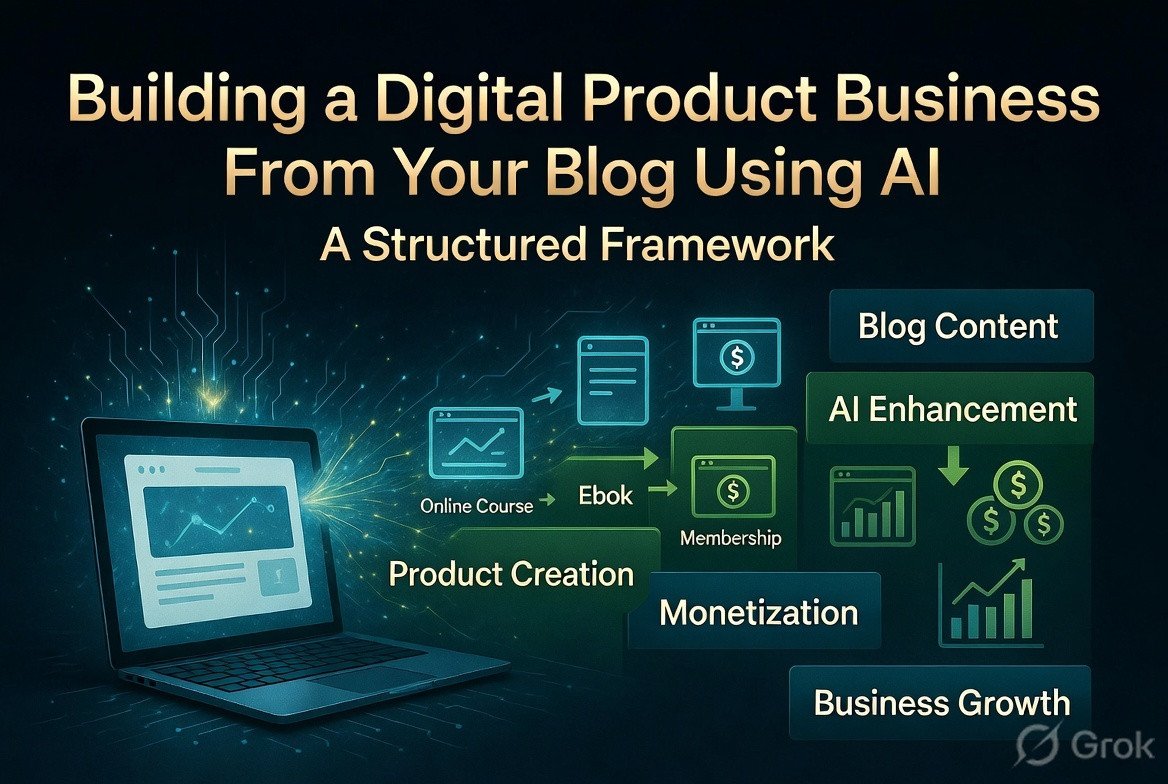
Blogging as a business model has two phases. Phase one is building traffic and an audience. Phase two is converting that audience into revenue through products rather than relying entirely on advertising or affiliate commissions.
Most bloggers understand phase two is more financially sustainable than phase one alone. The barrier has historically been production time and technical complexity. AI removes both barriers significantly.
This post outlines a structured framework for building a digital product business from an existing blog, with specific AI applications at each stage.
Why Digital Products Over Other Monetization Models?
Before the framework, the financial case for digital products over alternatives:
- Advertising (AdSense/display): Revenue scales with traffic linearly. Typical RPM rates require very high traffic volumes to generate meaningful income. Revenue is entirely dependent on platform policy decisions outside your control.
- Affiliate marketing: Revenue scales with audience trust and conversion rates. Income is dependent on third-party product quality and commission structures you do not control.
- Digital products: Revenue scales with audience size but is not strictly linear. A single product launch to an existing audience generates revenue independent of ongoing traffic. Margin is significantly higher since there is no cost of goods beyond initial production.
The math favors digital products at audience sizes where advertising and affiliate income plateaus.
The Digital Product Spectrum
Not all digital products carry equal production complexity or price potential. Structured from lowest to highest on both dimensions:
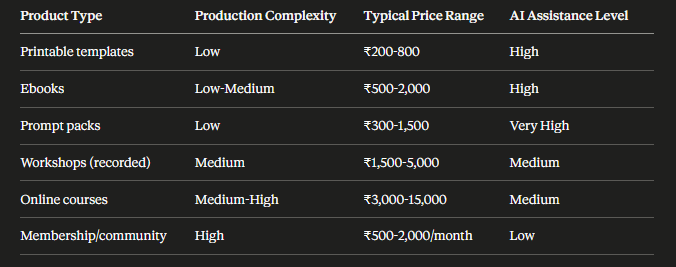
Entry point recommendation based on audience size and existing content library:
- Under 1,000 subscribers: Start with templates or prompt packs. Low production time, immediate revenue test.
- 1,000-5,000 subscribers: Ebook or recorded workshop. Higher price point, manageable production.
- Above 5,000 subscribers: Online course or membership. Justified production investment given audience size.
Phase 1: Identifying What Your Audience Will Actually Pay For
This is the step most bloggers skip by jumping directly to product creation based on what they want to make rather than what their audience has demonstrated willingness to pay for.
AI-assisted demand identification:
Prompt structure:
“Here are the most common questions and comments I receive from my blog audience: [paste examples]. Identify patterns that suggest a specific knowledge gap someone would pay to have filled systematically rather than answered in a single blog post.”
The distinction between “free blog post answer” and “paid product answer” is important. Products solve problems that require structured, sequential learning or reference material the user returns to repeatedly. One-time informational questions belong in blog posts, not products.
Validation before production:
Run a pre-sale or waitlist before building anything. Use AI to write the pre-sale landing page copy, but do not produce the product until you have confirmed demand through actual signups or purchases.
Minimum validation threshold before full production: 20-30 genuine waitlist signups from your existing audience, or 3-5 pre-sale purchases at full price.
Phase 2: Product Creation With AI
For ebooks and guides:
Prompt structure:
“Create a detailed chapter outline for an ebook titled [title] targeting [audience]. The ebook should solve [specific problem] and take the reader from [starting point] to [outcome]. Include chapter titles, main points per chapter, and suggested length per chapter.”
Use AI to draft each chapter individually, then edit for your voice, add personal examples, and verify all factual claims before finalizing.
For templates and prompt packs:
These are the highest AI-leverage products because AI can generate the actual product content directly. A prompt pack for bloggers, for example, can be substantially drafted by AI with your curation and testing adding the genuine value.
For online courses:
Refer to the course creation framework covered in a previous thread on this forum. The production workflow applies directly here.
Phase 3: Pricing Strategy
Pricing digital products is a strategic decision with measurable implications most bloggers undervalue.
Core pricing principle: Price based on the value of the outcome delivered, not the volume of content included.
A checklist that saves a blogger 5 hours per week is worth more than an ebook that takes 3 hours to read, even if the ebook contains more words. Price accordingly.
AI-assisted competitive pricing research:
“What is the typical price range for digital products in the [niche] space targeting [audience]? What factors distinguish products priced at the high end versus the low end of this range?”
Cross-reference with actual competitor product pages. AI pricing data requires current market verification.
Pricing structure options worth testing:
Single price point (simplest, easiest to communicate)
- Tiered pricing with a basic and premium version
- Bundle pricing combining multiple lower-priced products
- Payment plan for higher-priced products above ₹5,000
Phase 4: Sales Infrastructure
Sales page: Use AI to draft using a problem-agitation-solution framework as outlined in the course creation post. Key addition for digital products: include specific, measurable outcome statements rather than generic benefit claims.
Email sequence: A five to seven email launch sequence drives the majority of digital product revenue for most bloggers. AI drafts the structure, you add specificity and personal credibility signals.
Platform selection:
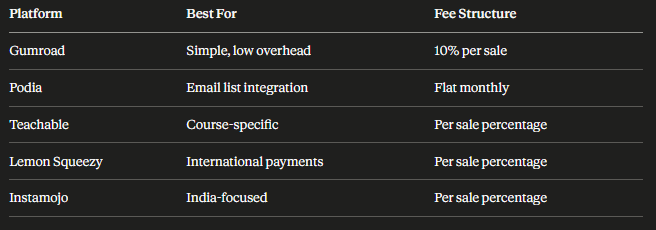
For India-based bloggers, Instamojo and Razorpay reduce payment friction for domestic customers significantly compared to international platforms.
Phase 5: Post-Launch Optimization
AI-assisted review analysis:
After launch, collect customer feedback and run it through AI:
“Here is feedback from customers who purchased [product name]: [paste feedback]. Identify the three most common points of confusion, the aspects customers found most valuable, and any specific improvements mentioned more than once.”
This produces a prioritized improvement list for the next product version without manually synthesizing individual reviews.
Evergreen vs launch model decision:
Some digital products perform better as evergreen purchases (always available, consistent passive revenue). Others perform better with periodic launch windows that create urgency.
AI can help you model both approaches based on your audience size and email list engagement rates, but the final decision requires your own data from the first launch cycle.
Summary Framework
Identify audience demand signals
↓
Validate with pre-sale or waitlist
↓
Produce product using AI-assisted workflow
↓
Price based on outcome value
↓
Build sales page and email sequence
↓
Launch to existing audience first
↓
Collect feedback and optimize
↓
Scale to cold traffic once conversion rate is confirmed
The framework above is not complex. The execution discipline of following it sequentially rather than skipping validation and pricing steps is what separates successful product launches from ones that produce disappointing results despite high production quality.
Tags: Digital Products, Blog Monetization, AI for Digital Products, Online Business, Passive Income, Ebook Creation, Sell Online, Blogging Business, AI Tools, Monetize Blog 2026, AI Forum, AI Webloggers
I like this idea because many bloggers only focus on ads and affiliate marketing, but digital products can provide a more stable income. AI can definitely save time by helping create eBooks, checklists, templates, and course outlines. However, I think it’s still important to add our own knowledge and experience so the product offers real value. A useful digital product can keep generating income for a long time, making it a smart way to grow a blogging business.
WOW.. for marketers like me… this post is very useful, in 2026 every marketers should adapt to the AI ecosystem..
I personally felt the info shared in Phase 5: Post-Launch Optimization is necessary for all to include in their launch strategy..
For product marketing, I keep it simple with the help of AI..
I use AI to write email sequences, create social media posts, and even generate sales page headlines.
For example, I feed my product description into Claude and ask it to write 5 different versions of a LinkedIn post or Instagram caption.
It also helps me create content calendars and ad copy variations quickly. Anyother suggestions?