
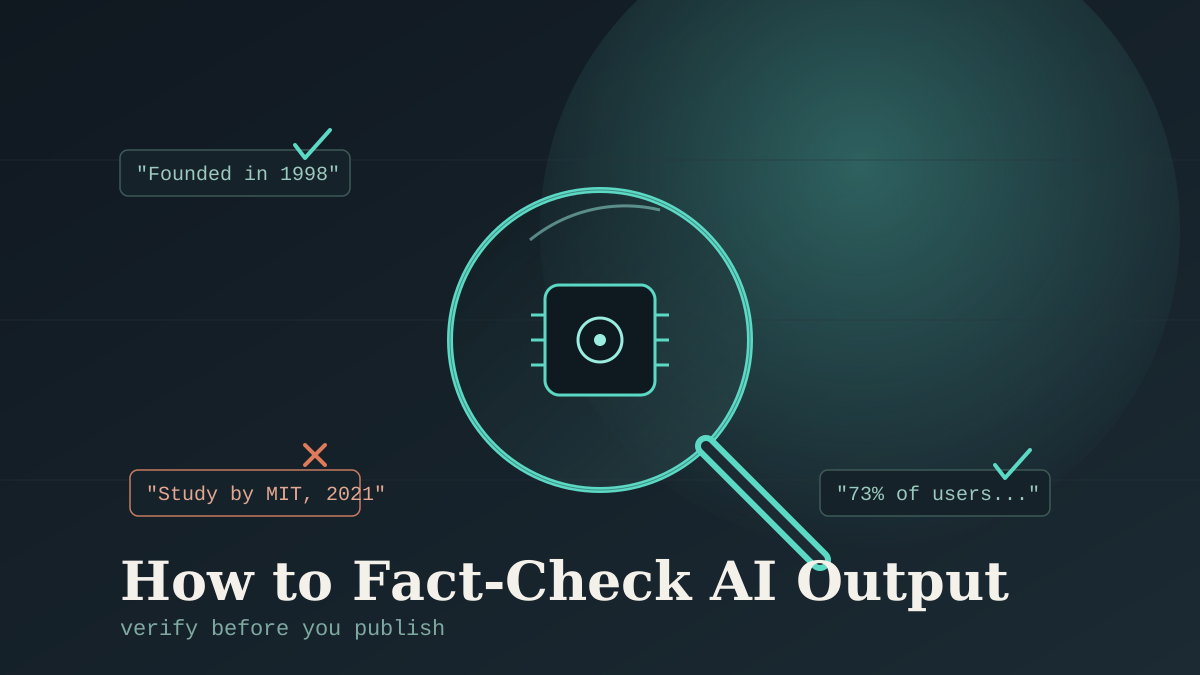
AI tools are great at writing fast. But fast is not the same as correct. AI can sound very confident even when it is wrong. This is why fact-checking is one of the most important skills you need when using AI.
Let’s break it down in simple steps.
1. Know That AI Can “Make Things Up”
AI tools do not “know” facts the way humans do. They predict the next word based on patterns they learned from huge amounts of text. Sometimes this means they create information that sounds real but isn’t. This is called a “hallucination.”
Examples of AI hallucinations:
- A fake statistic that sounds believable
- A study or research paper that does not exist
- A quote from a real person that they never actually said
- Wrong dates, names, or numbers
If you remember one thing from this post, remember this: AI can be wrong with full confidence. It will not warn you when it’s guessing.
2. Never Trust Numbers Without Checking Them
Numbers are the easiest thing for AI to get wrong, and the easiest for readers to question. Before publishing any number AI gives you:
- Search for the number using a simple Google search.
- Try to find the original source (a government website, a research paper, a news article from a trusted outlet).
- Check if the number matches the date and context. (A 2019 stat used as “current” data is misleading.)
If you cannot find the source after a few minutes of searching, it’s safer to remove the number or rewrite it as a general statement instead of a specific stat.
3. Check If Quotes Are Real
AI sometimes invents quotes and attaches them to real, famous people. This is risky because:
- It can make the real person look bad.
- It can mislead your readers.
- It can even cause legal trouble in some cases.
Before using any quote:
- Search the exact sentence in quotation marks on Google.
- Check if it appears on a trusted site (interview, article, official statement).
- If you cannot find the original source, do not use the quote at all.
4. Verify Names, Titles, and Roles
AI can mix up people’s names, job titles, or companies. For example, it might say someone is the “CEO” when they’re actually the “co-founder,” or get a person’s current role wrong.
Simple checks:
- Search the person’s name along with their current job title.
- Check official sources like LinkedIn or the company’s official website.
- Be extra careful with anyone whose role may have changed recently — AI often doesn’t know about recent changes.
5. Double-Check Studies and Research Claims
AI loves saying things like “studies show…” or “research proves…” But many times, there is no real study behind that sentence. Or the study exists but says something slightly different.
What to do:
- Ask yourself: did the AI name a specific study, author, or journal? If not, that’s a warning sign.
- If a study is named, search for it directly. Try Google Scholar or a simple web search.
- Read at least the summary (called an “abstract”) to confirm it actually supports the claim.
- If you can’t verify it, simply remove the claim or change it to something more general, like “many experts believe…” (only if that’s actually true).
6. Be Careful With Dates and Timelines
AI can confuse events, dates, or the order in which things happened. This is especially common with:
- Recent news (AI may not know about things after its training cutoff)
- Fast-changing topics (technology, politics, sports records)
- Historical events with multiple similar dates
Always check the latest date or event with a quick search, especially if your topic is something that changes often.
7. Cross-Check With More Than One Source
Never rely on just the AI’s word, and don’t rely on just one outside source either. A good rule is to check at least two independent sources before trusting a fact.
- If two unrelated, trustworthy sources agree, the fact is more likely to be true.
- If you only find one weak source (like a random blog), treat the claim as unverified.
- Be extra cautious if a fact only appears on AI-generated content farms repeating the same unverified claim.
8. Use Fact-Checking Websites for Big Claims
For claims that are important, surprising, or controversial, use dedicated fact-checking resources:
- Search engines (start simple, search the exact claim)
- Fact-checking sites like Snopes or Reuters Fact Check
- Official government or organization websites for statistics
- Academic databases for research claims
This step takes a little extra time but saves you from publishing something embarrassing or false.
9. Ask the AI Itself to Show Sources (But Don’t Stop There)
Some AI tools can show links or sources for their claims. This is helpful, but don’t treat it as the final step:
- Click the link and read it yourself. Don’t assume the source actually says what AI claims it says.
- Check if the source is trustworthy (a real news site vs. a random unknown blog).
- Remember: even when AI provides a source, it can still misread or misrepresent what that source says.
10. Build a Simple Fact-Checking Habit
You don’t need to be an expert to fact-check well. You just need a simple habit you repeat every time:
- Read the AI’s draft.
- Highlight every fact, number, quote, name, or date.
- Search each one individually.
- Remove or fix anything you cannot verify.
- Add a link or source for important claims.
This turns fact-checking from a scary, overwhelming task into a simple checklist you do every time, almost automatically.
Final Thoughts
AI is a great writing assistant, but it is not a reliable fact-checker on its own. Think of AI like a helpful but overconfident friend — sometimes right, sometimes wrong, but always sure of itself. Your job as the writer is to slow down, double-check, and only publish what you can actually confirm.
A few extra minutes of checking can save you from publishing wrong information, losing reader trust, or damaging your reputation. Build the habit now, and it will become second nature over time.
#FactCheckAI #AIAccuracy #AIHallucination #ContentWriting #AITips #TrustworthyContent #AIWritingTools #ContentQuality #VerifyBeforeYouPublish #AIForBeginners #ReliableContent #AIWritingHelp #DigitalContentTips #SimpleAITips
This checklist is something every blogger should bookmark. I want to add a real-world angle to this: skipping fact-checking doesn’t just risk an embarrassing comment section, it can actually hurt your site’s long-term performance.
Here’s what I’ve seen happen when AI errors slip through:
A few minutes of verification really is cheap insurance for your site’s credibility.
@LinkBlogs I don’t think 70% of bloggers/writers who uses AI will change their workflow and do FACT Check AI Output… 😄
Instead, to tackle this situation AI should improve its ability to deliver quality and reliable output, this is what expected by many AI users around the globe…. 😆 😆 😆 😆 😆 😆 😆 😆
@Stayalive actually made the most honest point in this entire thread, even if it was half-joking. Most bloggers are not going to change their workflow. That is just the reality.
But here is the part nobody is saying out loud: the ones who skip fact-checking are not just risking their reputation. They are quietly building a site that Google is learning to trust less with every published error. You do not see the penalty coming. You just notice traffic flattening for no obvious reason six months later.
The checklist in this post is solid, but I want to add one thing that is missing: fact-checking needs to happen at the prompt level, not just after the output. If you give AI a vague brief, you are basically inviting hallucinations from the start. Tighten the input, reduce the garbage output.
Two prompts I use before any research-heavy post:
That second one alone has caught more errors before they hit my draft than any post-output checklist ever did. Fix the process at the source, not just the symptom at the end.
The overconfident AI friend analogy in the original post is accurate. The problem is most bloggers treat that friend like an expert witness instead of a first draft machine.
FactCheckAI,AI Hallucination,AI Content Accuracy,Prompt Engineering, AI Blogging Mistakes,Verify AI Output,Content Quality,SEO Trust Signals,AI Writing Workflow,Reliable Content 2026