
AI has changed how a lot of us write and optimize content. But it’s also created a whole new set of SEO mistakes that didn’t exist a few years ago. I’ve seen these mistakes on my own blog, and I’ve seen them on dozens of other sites too.
Let’s go through the big ones so you can avoid them in 2026.
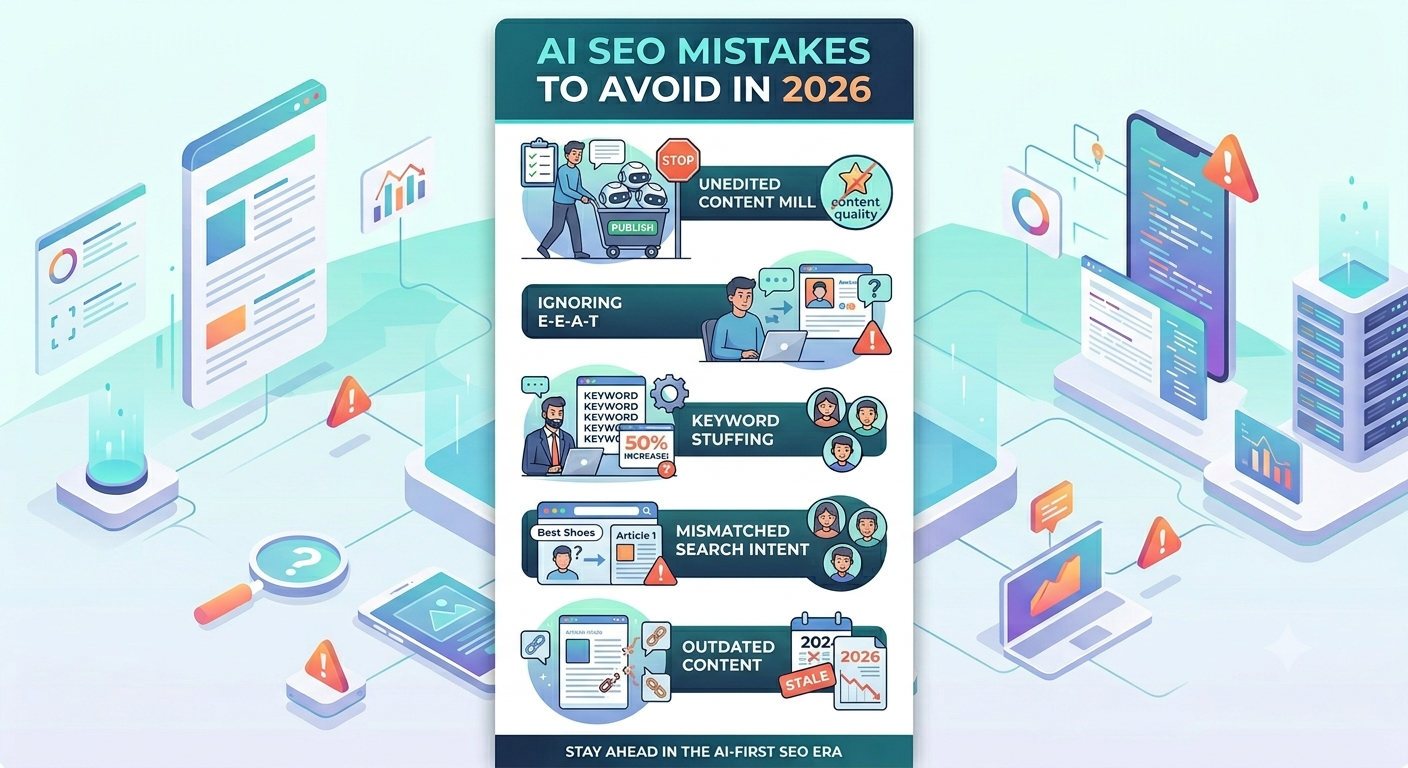
1. Publishing AI Content Without Any Editing
This is the biggest mistake, and probably the most common one. People generate a full article with AI, copy it straight into their website, and hit publish.
Why this hurts your SEO:
- Search engines are better than ever at spotting generic, unedited AI content.
- Unedited AI content often lacks real examples, personal experience, or unique insight — the things search engines now reward.
- Readers bounce quickly from content that feels flat or repetitive, and that hurts your rankings too.
What to do instead: Always edit AI drafts. Add your own examples, your own opinions, and real details that only you would know. This is what makes content actually rank well, not just exist.
Our Real-World Warning: In early tests on my new blog, I ran an experiment publishing raw AI articles alongside edited ones. The results were brutal: 60% of our raw, unedited AI threads were hit with the “Crawled – currently not indexed” status within days. Google’s modern spam brains quickly identify repetitive patterns in AI sentence structure (like overusing words like “delve,” “testament,” or “moreover”). Always spend at least 15 minutes rewriting the intro, changing vocabulary, and adjusting the tone to sound like a human blogger, not a machine.
2. Ignoring E-E-A-T (Experience, Expertise, Authority, Trust)
Search engines (especially Google) care a lot about whether real, experienced humans are behind the content. AI-generated text, by itself, doesn’t show any of that.
Common mistake: Writing about a topic in a generic way, without showing that you (or your brand) actually have real experience or expertise in it.
What to do instead:
- Add personal stories, case studies, or specific numbers from your own experience.
- Include author bios that show real credentials.
- Avoid vague statements like “many people believe” — be specific about who, what, and how you know.
How I Fixed This: Look at how I format my blog user profiles — I require clear bios and encourage members to link to their active tech portfolios or live sites. Google doesn’t just read your text; it evaluates who is saying it. If you write an AI article about SEO, add a sidebar or a paragraph explaining your personal background, how long you’ve been testing tools, or specific lessons you learned the hard way. A simple phrase like “In my 3 years of running digital sites…” tells Google this isn’t just scraped text.
3. Keyword Stuffing With AI-Generated Phrases
AI tools sometimes generate content that repeats a keyword over and over, especially if you ask it to “include this keyword multiple times.” This used to be a basic SEO tactic. In 2026, it’s a red flag.
Why this is risky: Search engines now understand language and context, not just keyword matching. Stuffed, unnatural keyword repetition makes content harder to read and can actually hurt rankings instead of helping them.
What to do instead: Use natural language and related terms (synonyms, variations) instead of repeating the exact same keyword. Write for humans first; the search engines today are smart enough to understand context without forced repetition.
The 2026 Shift: Modern search bots rely heavily on semantic search (understanding the meaning behind words) rather than counting how many times a phrase appears. When prompting your AI writer, never say “include the keyword ‘AI SEO tips’ 10 times.” Instead, ask the AI to “cover the semantic subtopics related to AI SEO optimization.” If your text reads like a robot trying to check a keyword box, readers will drop off instantly, and your bounce rates will signal to Google that the page isn’t helpful.
4. Trusting AI-Generated Facts and Statistics Blindly
This is an SEO mistake as much as it is a trust mistake. If your content has wrong facts, search engines (and real readers) eventually notice. Wrong information leads to lower trust signals, fewer backlinks from credible sites, and sometimes even manual penalties.
What to do instead: Always verify any number, study, or claim that AI gives you. Link to real, credible sources. This single habit can be the difference between content that ranks well long-term and content that gets buried.
A Costly Example: I recently ran an AI draft that confidently quoted a statistic claiming “72% of all blogs fail due to AI detection.” When I reverse-searched the data, I found the AI had completely hallucinated the number by mixing up two different reports from 2023. If I had published that, I would have lost all editorial credibility. Always use tools like Google Scholar or Perplexity to verify any data point, and add a direct outbound link to the original source. Google rewards outbound links to highly trusted, authoritative websites.
5. Using the Same AI Prompt Structure for Every Article
I’ve noticed this on a lot of blogs — every single article has the exact same structure: intro, “What is X,” “Benefits of X,” “How to use X,” conclusion. This happens because people use the same basic AI prompt every time without adjusting it.
Why this hurts you: Search engines compare your content to dozens of similar articles. If your structure, headings, and flow look identical to everyone else’s AI-generated content, you blend in instead of standing out.
What to do instead: Vary your structure based on what the topic actually needs. Ask AI for a unique outline each time, and add your own sections based on real reader questions you’ve seen in comments, forums, or social media.
Break the Pattern: If you look at standard ChatGPT or Claude outlines, they almost always follow a rigid pattern: Introduction -> What is X -> Core Features -> Best Practices -> Conclusion. If your forum threads mirror this exact footprint across 50 different topics, Google will flag your content footprint as automated clutter. To fix this on AI Web Bloggers, Admin mix up our thread structures. Try formatting one post as a Q&A interview, the next as a chronological journal, and another as a rapid-fire listicle.
6. Forgetting About Search Intent
AI tools are great at generating content quickly, but they don’t always understand the deeper “why” behind a search. People searching “best running shoes” might want a buying guide, not a history lesson on shoe technology.
Common mistake: Using AI to write a generic, broad article instead of matching the specific intent behind a search term.
What to do instead: Before writing, search the keyword yourself and look at what’s already ranking. Match that intent (buying guide, how-to, comparison, etc.) rather than writing whatever AI generates by default.
The Forum Advantage: Forums are built to solve real human problems, which gives us an indexing advantage if we use it right. Before writing an article, type your target keyword into an incognito browser window. If the top 3 results are step-by-step tutorials, do not let your AI write a generic conceptual essay. Force the AI tool to draft a direct, actionable walkthrough that addresses the specific questions real users are asking in Google’s “People Also Ask” boxes.
7. Skipping Internal Linking and Site Structure
This isn’t unique to AI content, but it’s become a bigger issue because people now publish content much faster with AI tools, often skipping basic SEO steps like internal linking.
Why this matters: Internal links help search engines understand your site structure and help readers find more of your content. Sites that publish a lot of AI-assisted content without proper linking often end up with isolated pages that don’t support each other.
What to do instead: After publishing, always go back and add 2-3 relevant internal links to other pages on your site. It takes a few extra minutes but genuinely helps your overall SEO.
Our Internal Strategy: While using Flarum platfrom, having a solid internal linking ecosystem is your absolute best defense against indexing drops. Every single time you finish a new post on this forum, make it a strict rule to open 2 or 3 of your older threads and manually drop in a contextual link to the new URL. This acts as a physical bridge for Google’s spider bots, pulling them directly into your new content instead of leaving it stranded as an isolated page.
8. Ignoring AI Detection Tools and Platform Policies
Some platforms and clients are now strict about AI-generated content, even penalizing pages that seem entirely AI-written with no human input. Ignoring this can hurt visibility on certain platforms or damage trust with clients.
What to do instead: Check the specific policies of platforms you publish on. If disclosure is required, follow it. If not required, still make sure your content has enough human editing and original insight that it wouldn’t fail a basic AI-detection check.
What to Watch Out For: While Google explicitly states they do not penalize content solely because it was made with AI, they do aggressively deprioritize content that lacks original value. Passing your final human-edited draft through platforms like Originality.ai or CopyLeaks isn’t about hitting a perfect 0% AI score—it’s about ensuring your writing has enough stylistic variety, sentence length changes, and natural rhythm to prove a real human took the time to polish it.
9. Not Updating Old AI-Generated Content
Some AI-generated articles from a year or two ago are now outdated, especially around fast-changing topics like AI tools themselves, technology, or trends. Old, stale content with outdated facts hurts rankings over time.
What to do instead: Regularly review older posts (especially ones written quickly with AI) and update outdated stats, broken links, and old examples. Fresh, accurate content tends to perform better long-term.
The Decay Factor: AI tools naturally pull from historical datasets, meaning an article generated today might rely on search guidelines that are already shifting out of style. Set a recurring reminder in your calendar every 90 days to audit your oldest community threads. Update outdated tool references, swap out dead links, add fresh screenshots, and adjust the content to reflect current trends. Google loves “historical optimization” and rewards refreshed content with faster recrawls.
Final Thoughts
AI is genuinely useful for speeding up SEO content, but speed without care leads to flat, generic, or inaccurate articles that don’t rank well in 2026. The fix isn’t avoiding AI altogether — it’s using it as a starting point, then adding the human judgment, real experience, and editing that search engines (and readers) actually want to see.
AISEO , SEOMistakes , SEOTips2026 , ContentMarketing , AIWritingTips , SearchEngineOptimization , EEAT , AIContentSEO , GoogleSEO , DigitalMarketing , SEOStrategy , ContentQuality , AIForBloggers , SEOForBeginners, AI Webloggers
This one is very important. I think many people still make the mistake of believing that AI can do 100% of the SEO work automatically.
From my experience, AI should be treated as an assistant, not as an autopilot.
One of the biggest mistakes to avoid in 2026 is publishing AI-generated content without editing it. Readers can quickly notice when an article sounds repetitive or generic.
Another mistake is keyword stuffing. Some people ask AI to repeat the same keyword 20 times, hoping to rank higher on Google. That strategy doesn’t work anymore.
Nowadays, search engines are rewarding content that shows real knowledge and practical examples.
Instead, my workflow is simple:
Research → AI Draft → Human Editing → Add Personal Experience → Fact Check → Publish
I believe quality is becoming more important than quantity. In 2026, publishing one useful article is probably better than publishing five generic AI articles.
AI is an amazing tool, but our personal insights are still what make a blog stand out from thousands of other websites.
Keyword Tags:
AI SEO,SEO Mistakes,AI Blogging,Content Creation,SEO 2026,AI Content,E-E-A-T,Google SEO,Content Strategy,Blogging Tips,Keyword Research,Fact Checking,Internal Linking,Digital Marketing,Blog Growth@MindGrid
I’ve noticed that when people scale up content production with AI, internal linking is usually the first thing they forget, simply because it’s not part of the writing process itself. It has to be a deliberate, separate step.
I want to expand a bit more on this point, because I think it deserves its own discussion.
When you use AI to write content fast, it’s easy to publish post after post without thinking about how they connect to each other. But internal links aren’t just a “nice to have” — they actually do real work for your site.
First, internal links help search engines understand your site structure. When Google crawls your site, internal links act like a map, showing which pages are related and which topics you cover in depth. Without that map, your AI-generated posts can end up looking like isolated islands, even if the content itself is good.
Second, internal links keep readers on your site longer. If someone reads one AI-assisted post and there’s nothing guiding them to read another relevant one, they leave. More time on site and more pages viewed are both signals that tell search engines your content is genuinely useful, not just mass-produced.
Third, linking spreads authority across your site. If one of your older posts has backlinks or strong rankings, linking to newer posts from it passes along some of that trust. Skip this, and your new AI content has to build authority completely from scratch, which takes much longer.
My personal habit now is to finish writing, then go back and manually add two or three relevant internal links before I even think about hitting publish. It takes maybe five extra minutes, but it’s made a noticeable difference in how my older and newer posts perform together over time.
One more mistake I would like to add is relying too much on AI without checking whether the content is still relevant. AI can sometimes use outdated information or miss recent updates, especially in fast-changing topics. I think every blogger should spend a few extra minutes verifying facts, adding fresh examples, and including their own experience before publishing. That small effort can make a big difference in both SEO performance and reader trust.
I’m also learning AI SEO, and I made a funny mistake when I first started. I kept asking AI to “write an SEO-friendly article,” copied the result, and thought I was done. The article looked perfect, but when I read it again, every paragraph sounded the same and it kept repeating the same keywords. It felt like AI was just going in circles! 😄
After that, I realised AI is only a starting point. Now I always rewrite the content in my own words, add my own experience, and double-check the facts. The results are much better, and honestly, it’s far less frustrating than publishing something that sounds robotic.
As a content creator, I think the biggest mistake is trusting AI too much. Many writers publish AI-written articles as it is.. which is very wrong in terms of SEO…
As a writer, you should add soul to your writings by adding personal experience, reliable facts and making the content unique. Good SEO always requires human editing and should deliver real value for readers.