
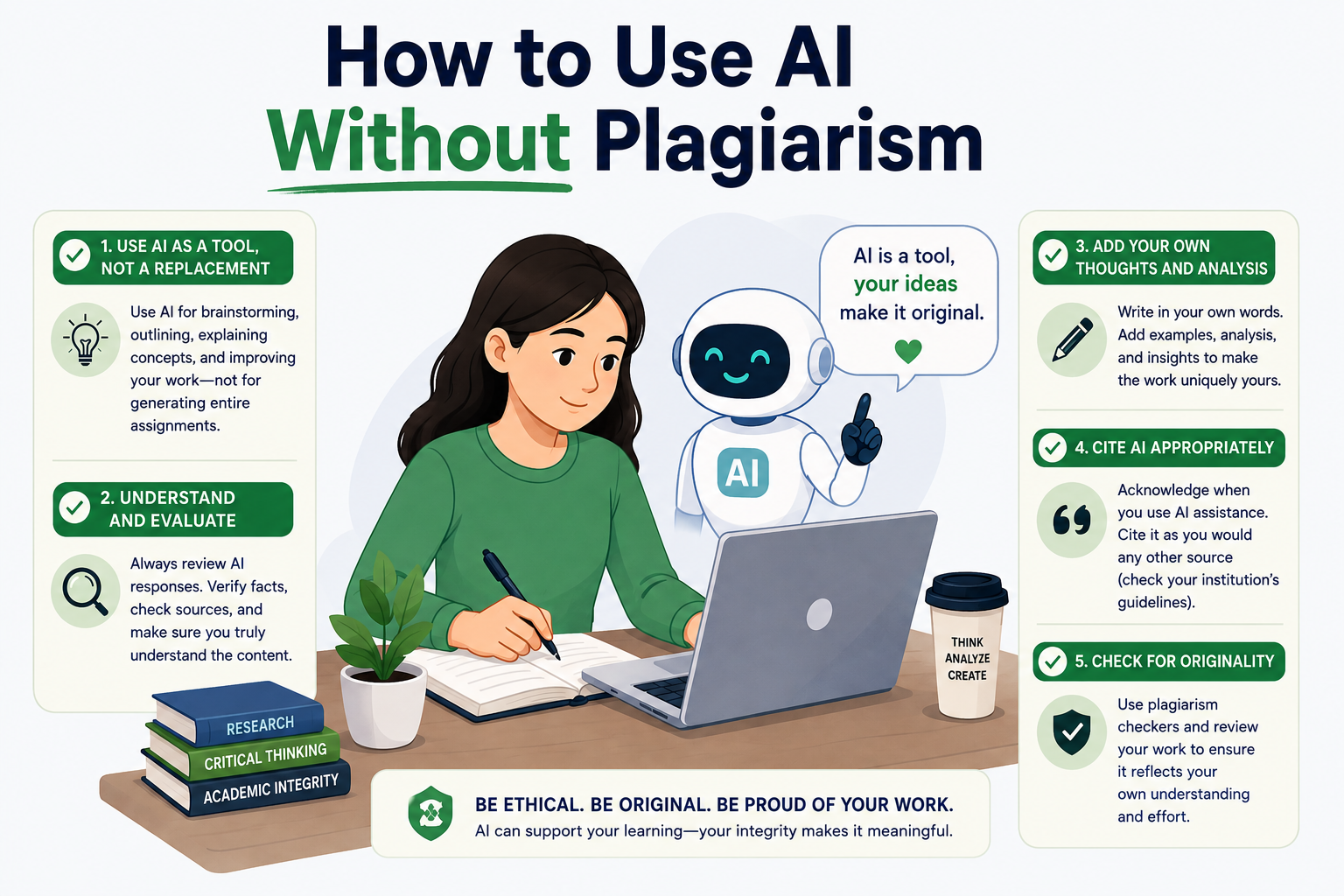
AI writing tools have become part of everyday content creation, but they’ve also raised a tricky question: where’s the line between “using AI to help” and “plagiarizing”? Since I started using AI tools for research and drafting, I’ve had to think through this carefully — both for ethical reasons and because plagiarism detectors and search engines are getting smarter about catching AI-generated duplicate content.
Here’s what I’ve learned about using AI responsibly without crossing into plagiarism.
1. Understand What “AI Plagiarism” Actually Means
Plagiarism isn’t just copy-pasting someone else’s sentences. With AI, it shows up in a few sneaky forms:
- Direct reproduction: The AI spits out text that closely mirrors a source it was trained on (rare with modern models, but it happens with very specific or niche content).
- Patchwriting: Lightly rewording someone else’s ideas or structure without genuinely transforming them — this counts as plagiarism even if no exact phrase matches.
- Self-plagiarism via AI: Reusing the same AI-generated paragraph across multiple articles or clients without disclosure.
- Idea theft without attribution: Taking a unique framework, study, or argument from a source and presenting it as your own original insight.
Once you know these categories, it’s easier to catch yourself before publishing.
2. Treat AI Output as a Draft, Not a Final Product
The single biggest mistake people make is publishing AI output verbatim. AI models generate text based on patterns learned from huge datasets — they’re not “creating” in the way a human does, and they don’t have a built-in sense of originality. Always treat the first draft as raw material:
- Rewrite sentences in your own voice.
- Add your own examples, anecdotes, or data.
- Challenge or expand on the AI’s claims with your own analysis.
This step alone eliminates most plagiarism risk because the final piece becomes a blend of AI structure and human originality.
3. Always Fact-Check and Source Claims Yourself
AI models can confidently generate statistics, quotes, or “facts” that don’t exist — sometimes called hallucinations. If you publish these without checking, you’re not just risking plagiarism; you’re risking spreading misinformation. Before publishing:
- Verify every statistic against a primary source.
- If the AI references a study or expert, confirm it actually exists.
- Add proper citations and links for any factual claim, even if you rewrote the sentence.
This habit also protects you legally and reputationally — readers trust content that’s verifiably accurate.
4. Run Your Content Through Plagiarism and AI-Detection Tools
Even if you’ve heavily edited your draft, it’s smart to run a final check using:
- Plagiarism checkers (Copyscape, Grammarly, Turnitin) to catch any accidental overlap with existing web content.
- AI-detection tools (Originality.ai, GPTZero) if your platform or client requires disclosure of AI involvement.
These tools aren’t perfect, but they’re a good safety net, especially when you’re publishing at volume.
5. Use AI for Structure and Ideation, Not Final Wording
One of the safest ways to use AI is to lean on it for the skeleton of a piece rather than the finished sentences:
- Ask it to outline a topic.
- Use it to brainstorm angles or counterarguments.
- Have it summarize research so you can read faster.
Then, write the actual prose yourself. This naturally avoids “AI plagiarism” because the final wording is genuinely yours, even if the AI helped you think.
6. Be Transparent When Required
Many publications, academic institutions, and content platforms now have explicit AI-use policies. Some require disclosure (e.g., “This article was drafted with AI assistance and edited by a human”), while others ban AI content outright. Transparency protects you from accusations of dishonesty:
- Check your platform’s or client’s AI policy before submitting work.
- If unsure, default to disclosing AI involvement — it’s rarely penalized when done honestly, but hiding it can destroy trust if discovered.
7. Avoid Over-Reliance on a Single AI Model for Niche Topics
If you’re writing about a very specific or specialized subject, a single AI model might pull heavily from a narrow set of training sources, increasing the risk of accidental close paraphrasing. To reduce this risk:
- Cross-check AI output against multiple independent sources.
- Use multiple AI tools and compare outputs — if they converge on identical phrasing, that’s a red flag the underlying source is being echoed too closely.
- For highly technical or academic writing, always go back to primary literature rather than trusting AI’s summary.
8. Build a Repeatable Editing Workflow
Plagiarism risk drops dramatically when you have a consistent process rather than winging it each time. A simple workflow that works well:
- Generate AI draft (outline or rough copy).
- Rewrite in your own voice, section by section.
- Fact-check every claim and add citations.
- Run a plagiarism/AI-detection check.
- Final human read-through for tone, accuracy, and originality.
Treating this like a checklist — not an afterthought — turns occasional carefulness into a habit that protects your reputation long-term.
9. Respect Copyright Even When AI “Generates” Something Original-Seeming
AI tools can sometimes produce content stylistically very close to a known author, brand voice, or copyrighted work (especially with creative writing, jingles, or distinctive marketing copy). Even if no exact phrase matches, content that closely imitates a recognizable, protected style can raise legal and ethical issues. When in doubt, ask the AI to generate something more broadly styled, and add your own creative twist.
Final Thoughts
Using AI without plagiarism isn’t about avoiding the technology — it’s about using it as a collaborator rather than a replacement for your own thinking. The combination of human editing, fact-checking, transparency, and verification tools is what separates ethical AI-assisted content from lazy, risky copy-paste publishing. If you build these habits into your workflow now, you’ll save yourself a lot of headaches (and possible reputational damage) down the road.
#AIWriting #AIPlagiarism #ContentCreation #AIethics #PlagiarismFree #AItools #ContentMarketing #OriginalContent #AIWritingTips #DigitalContent #AIDetection #EthicalAI #Copywriting #ContentStrategy
Thanks for posting this. I think this is one of the most important topics for anyone using AI to create content. AI is a great assistant, but we should never use it as an excuse to copy someone else’s work or publish content without checking it.
There are several reasons why we should avoid plagiarism. First, it can damage our credibility. If readers discover that our content is copied, they are less likely to trust us again. Building trust takes a long time, but it can be lost very quickly.
Second, copied content doesn’t help us build a unique blog. Thousands of websites may already have similar information, so adding our own opinions, experiences, and examples is what makes our content valuable.
Another reason is SEO. Search engines aim to show useful and original content to users. While AI itself isn’t the problem, publishing duplicated or low-value content can hurt a website’s long-term performance. Instead of copying, I use AI to generate ideas, create outlines, or simplify difficult topics, and then I rewrite everything in my own style.
I also make it a habit to verify facts before publishing. AI can sometimes make mistakes or provide outdated information, so a quick fact-check is always worth the effort.
My simple workflow is:
Research → AI Outline → Write in My Own Words → Add Personal Experience → Fact Check → Publish
I believe this approach helps create content that is original, trustworthy, and genuinely useful for readers. AI should help us become better writers, not shortcuts to copying someone else’s work.
Keyword Tags:
AI Plagiarism,
Original Content,AI Blogging,Content Creation,SEO,Content Writing,AI Ethics,Fact Checking,Blogging Tips,Content Strategy,Google SEO,E-E-A-T,AI Tools,Blog Growth,Content MarketingAfter reading everyone’s thoughts, I think the biggest misunderstanding is that AI itself doesn’t cause plagiarism—how we use it does. If we simply copy the output and publish it, the content may become too similar to what thousands of others are creating. That is where the real problem starts.
I usually treat AI as a research partner instead of a content writer. I ask it to explain a topic, generate ideas, or create an outline. Then I add my own experience, examples, screenshots, and opinions before publishing. I also verify important facts from trusted sources because AI can sometimes make mistakes.
Another good habit is to write the introduction and conclusion in your own words. These sections help give your article a unique voice. AI can definitely save time, but originality comes from the human behind the keyboard. That combination of AI assistance and personal input is what creates content that readers and search engines are more likely to trust.